The wonderful Ruta Traslatio, which sails up the Ría de Arousa, offers beautiful coasts and landscapes and a deep spiritual meaning, plus something unique in the world: the only maritime and river Way of the Cross, 17 traditional cruceiros (stone crosses) marking the journey from Ribeira to Pontecesures.
Origin of the cruceiros
The cruceiro is a traditional religious feature all over Galicia, where there are more than 10,000 of them along paths, in squares, parks, cathedrals and private homes. Their origin goes back to the lares, the household gods who protected travellers, to whom the Romans dedicated inscribed altars, mainly at crossroads. As Christianity spread through the region, the altars were torn down and cruceiros were put in their place.
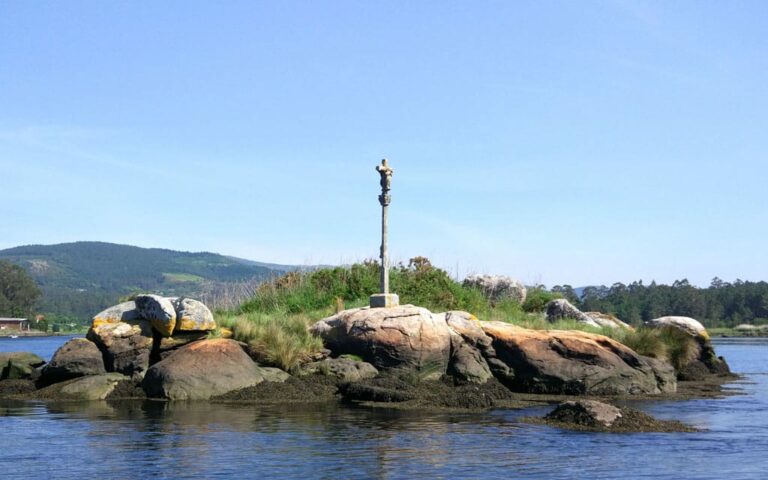
Basically, a cruceiro is a stone cross on top of a stone column. The cross usually shows a sculpture of Christ on one side and the Virgin on the other. Some are very simple, but many are richly decorated and several date back to the Gothic period.
The cruceiros of the Ruta Traslatio

Most of these 17 cruceiros, spread across banks and islets along the Arousa and Ulla Sea Way, date from the 1960s, when José Luis Sánchez-Agustino had the idea of using them to commemorate the maritime and river route followed by the stone boat that carried (hence the name Traslatio, “translation”) the body of St James the Apostle, beheaded in the Holy Land and accompanied on his miraculous journey by his two favourite disciples, Theodore and Athanasius.
Where to see the cruceiros

From Ribeira at the mouth of the Ría de Arousa to Pontecesures at the end of the Ruta Traslatio, these are the 17 cruceiros grouped by municipality.
- Ribeira: its cruceiro is the closest to the entrance of the Ría de Arousa, which the Christ at the top faces. On the shaft stands the Apostle as a pilgrim.
- Vilagarcía de Arousa: 5 cruceiros, on Malveira Grande island, Punta Corveiro, O Salgueiral, O Campanario and Punta Grandeiro.
- Rianxo: two cruceiros, at Punta Patiño and Rianxo (port).
- Catoira: three cruceiros, at Outeiriño, Illota Telleiras and Insua do Rato.
- Valga: two cruceiros, at O Texar and Cordeiro.
- Pontecesures: two cruceiros, in Praza dos Valeiros and at the Jacobean monument on the Roman Via XIX in Pontecesures.
- Boiro: one cruceiro at Cabo de Cruz.
- A Pobra do Caramiñal: one cruceiro near the Casa Mariñeira (tourist office).