Padrón is a small town between Pontevedra and Santiago de Compostela, the final stage of the Ruta Traslatio, where it joins the Portuguese Way. This Galician town, closely linked to the Way of St James, was founded in the 10th century, but its history goes back much further.
Originally it was not Padrón but the ancient settlement of “Iria Flavia”, a key community in the area in Roman times and the target of many invasion attempts in the Viking age. Padrón grew in importance, and its links with Santiago are perhaps the main reason why so many visitors choose to come here today.
The fascinating legend of Padrón and Santiago de Compostela

True or not, the legend says that Padrón owes its name to a large stone (the Pedrón) to which the boat carrying the remains of St James the Apostle was moored when it landed at “Iria Flavia” on its way to Santiago. From Padrón, his disciples Athanasius and Theodore carried the remains to Santiago, where they were buried.
St James had come from Palestine to what is now Spain to spread the word of God and stayed for several years. When he reached Galicia (AD 45), he regularly preached on a rocky hill on the outskirts of Padrón called “Santiaguiño do Monte”, where he also made a spring with miraculous powers flow. Back in Jaffa (Palestine) he was sentenced to death and soon beheaded. On hearing the news, Athanasius and Theodore hurried to Jaffa to bring back his remains.
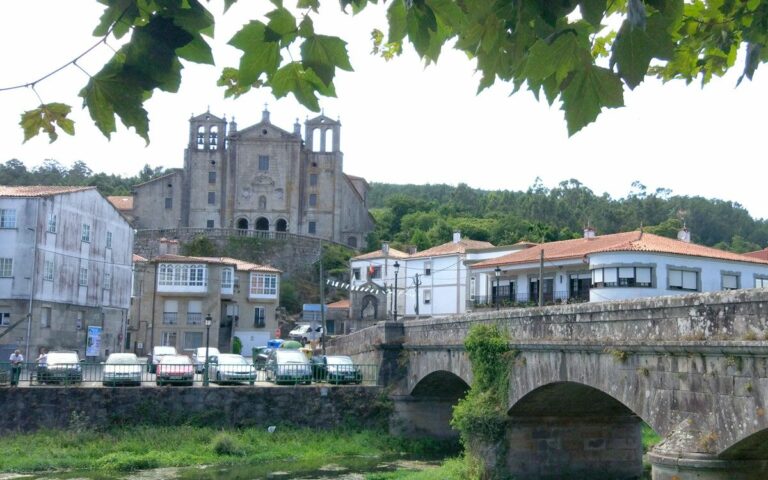
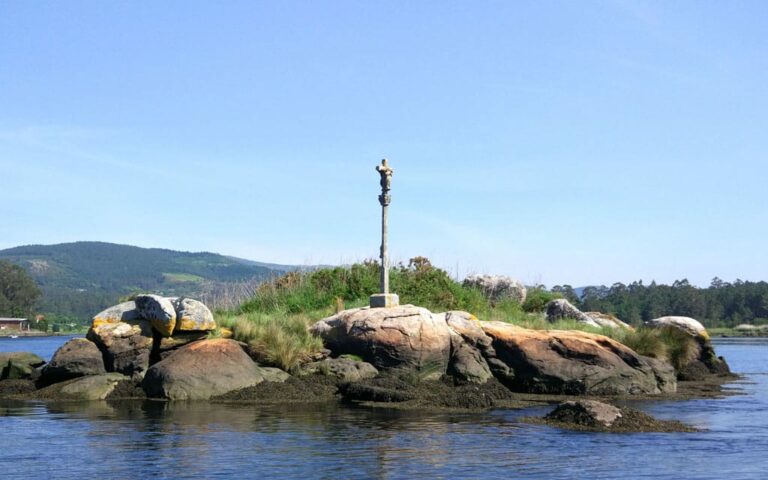
The “Pedrón” now rests on permanent display under the altar of the Church of Santiago in Padrón. You can visit the church and also see a replica of the stone on the riverbank opposite it. You can also visit the hill where the Apostle preached, now crowned by a cruceiro (stone cross), and the spring that, according to tradition, the saint made flow.
The Pedronía

The Pedronía is a pilgrim certificate that promotes the town of Padrón and the Way of St James through the lands of Iria Flavia. It certifies that the pilgrim has travelled to the place where the stone boat arrived.
You get the Pedronía after walking at least 18 km to Padrón, either from Santiago de Compostela or from any town on the Ría de Arousa along the maritime and river route.
At the end of the Ruta Traslatio, Padrón and its rich history offer many places worth visiting. Come and discover the treasures of this wonderful town!

Padrón suits all kinds of visitors: pilgrims on the Way of St James, literature lovers, those looking for stories and local flavours, or anyone who simply wants to head out into nature and enjoy beautiful surroundings will find what they are looking for in Padrón.
Tourism in Padrón
Padrón is the ideal place to explore at the end of the wonderful Ruta Traslatio. Steeped in history and closely tied to the Way of St James, it is one of those towns you can visit in a couple of hours, or stay a day or more to get to know its history, festivals, sights and food.
Birthplace of some of Galicia’s most famous people, above all Rosalía de Castro, Padrón has many fine examples of civil and religious architecture. It also hosts the largest open-air market in Galicia, and you can visit two places linked to St James. Today Padrón is also known as the home of its famous peppers, popular all over Spain and beyond.
Literature on the Way
Although Padrón is a very small town (about 9,000 inhabitants), it was the birthplace of two celebrated writers: Nobel Prize winner Camilo José Cela and Rosalía de Castro, the Romantic poet admired by all Galicians for her fight against social injustice in the 19th century.
On the lovely “Paseo del Espolón”, where the popular market is held every Sunday, two statues honour these two famous townspeople. There is also a large museum, the “Fundación Camilo José Cela”, in Iria Flavia (just a 5-minute walk from Padrón). And a short distance from the centre of Padrón (also within walking distance) you can visit the former home of Galicia’s most famous literary figure, the “Museo Rosalía de Castro”, one of the most visited museums in Galicia.
What you need to know about Padrón
The centre and streets of Padrón still keep their medieval layout and offer plenty of options for eating out, leisure and rest.
There is also a unique product that sets this town apart: the pepper from nearby Herbón, with Protected Designation of Origin since 2009.
The small Padrón peppers, grown in the greenhouses of Herbón (a parish of Padrón), are usually served fried as tapas. Their flavour is distinctive, they are very popular throughout Spain and can be quite expensive outside Galicia. If you try this local speciality and are surprised by how mild it is, be careful: a small share of them (about 10%) can be really hot (some people call them “Russian roulette”).
The famous Sunday market in Padrón, on the “Paseo del Espolón”, is the largest and most popular in Galicia, set in a large tree-lined park next to the River Ulla.
This busy market is one of the largest open-air markets in Galicia, with 600 stalls selling all kinds of products. On market days, all the shops in the centre are open.
Enjoy Padrón at the end of your journey along the Padre Sarmiento Route or the Spiritual Variant of the Portuguese Way, and discover everything it has to offer!
Places of interest in Padrón

- The Church of Santiago, with the “Pedrón” stone under its altar.
- The Carmen Convent and Fountain.
- The Romanesque churches of Santa María de Herbón (12th century) and Santa María a Maior de Iria Flavia (12th century, built on an ancient Roman temple from the 1st century AD destroyed by Almanzor in 999), considered the first Marian church in the world.
- Rosalía de Castro’s former home, now a museum.
- The Collegiate Church of Iria Flavia and its famous portico.
- The Camilo José Cela Foundation (museum).
- Santiaguiño do Monte.
- The “Paseo del Espolón” (where the market is held).
- The botanical and artistic garden, one of the oldest in Spain.
- Herbón (a district of Padrón), where the Pepper Festival is held in August.
- The Santiago Bridge, linking the old town with the area known as “A Trabanca”.